Relative Importance Key
High Medium Low
Criteria Transmission Data Rate Installation Latency Density Maintenance Migration
RATING
April/May/June 2020 I 21
a panel is too dense for the application. The appropriate
density depends on the ability of the high density panels
to provide adequate space for required labeling (particularly
panels without doors such as balanced twisted-pair
patch panels) and the need of the data center operations
team to use tools to insert and remove connections, particularly
for optical fiber patch panels.
Maintenance
How often will moves, adds, and changes (MACs)
be done? The higher the frequency, the more that
accessibility is required. However, the reverse is also
true. If the connections are intended to be “one and
done,” then accessibility can be sacrificed.
Migration
Is the cabling expected to last two or three generations
of data rates? Does the cabling need to have the flexibility
to change connector types to match potential future
physical media dependent (PMD) components and
equipment? These questions need to be considered prior
to specifying and installing the cabling infrastructure.
DATA CENTER TYPES
For the purposes of comparison, there are three categories of data centers:
• Traditional enterprise
• Cloud scale
• Hyperscale
It is important to note that although these categories of data centers are distinct, in reality the variety of data
centers across the world defies simple categorization. The categories discussed herein should be viewed as representative
values on a scale.
Each of these categories has a different set of cabling requirements. With so many individual data centers in each
category, especially the traditional enterprise, these ratings do not apply universally to the category. However, they are
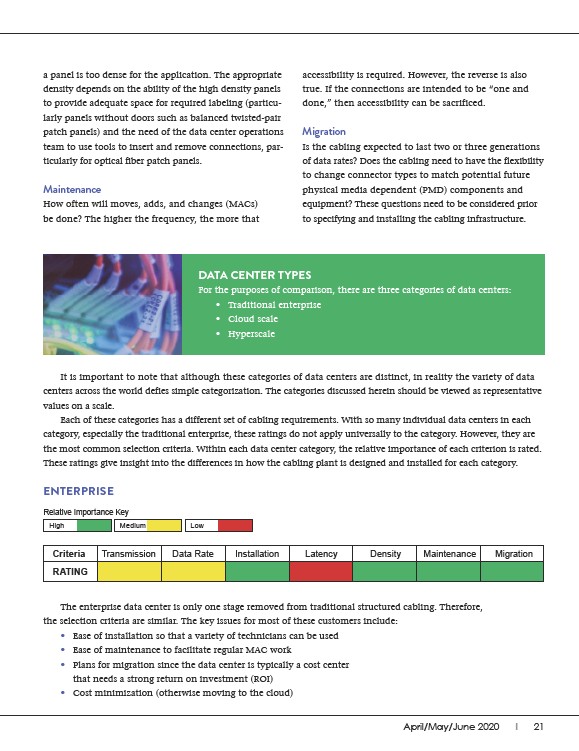
the most common selection criteria. Within each data center category, the relative importance of each criterion is rated.
These ratings give insight into the differences in how the cabling plant is designed and installed for each category.
ENTERPRISE
The enterprise data center is only one stage removed from traditional structured cabling. Therefore,
the selection criteria are similar. The key issues for most of these customers include:
• Ease of installation so that a variety of technicians can be used
• Ease of maintenance to facilitate regular MAC work
• Plans for migration since the data center is typically a cost center
that needs a strong return on investment (ROI)
• Cost minimization (otherwise moving to the cloud)