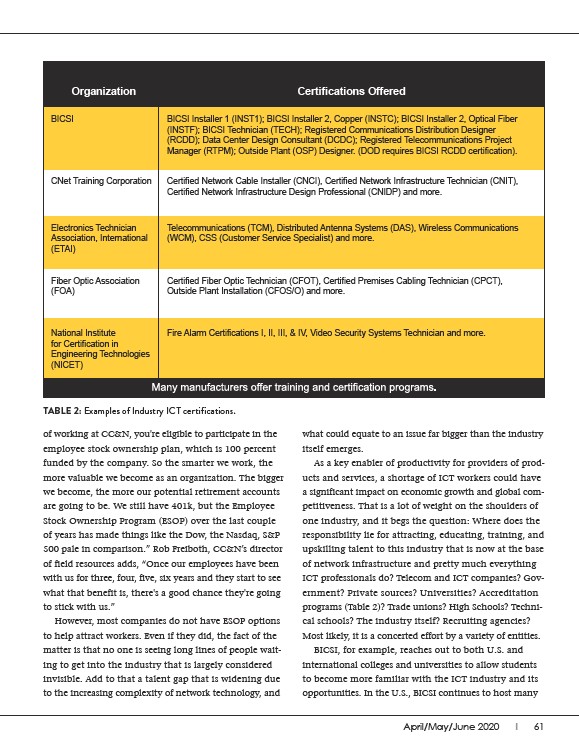
Certifications Offered
CNet Training Corporation Certified Network Cable Installer (CNCI), Certified Network Infrastructure Technician (CNIT),
Certified Network Infrastructure Design Professional (CNIDP) and more.
April/May/June 2020 I 61
Organization
BICSI BICSI Installer 1 (INST1); BICSI Installer 2, Copper (INSTC); BICSI Installer 2, Optical Fiber
(INSTF); BICSI Technician (TECH); Registered Communications Distribution Designer
(RCDD); Data Center Design Consultant (DCDC); Registered Telecommunications Project
Manager (RTPM); Outside Plant (OSP) Designer. (DOD requires BICSI RCDD certification).
Electronics Technician
Association, International
(ETAI)
Telecommunications (TCM), Distributed Antenna Systems (DAS), Wireless Communications
(WCM), CSS (Customer Service Specialist) and more.
National Institute
for Certification in
Engineering Technologies
(NICET)
Fire Alarm Certifications I, II, III, & IV, Video Security Systems Technician and more.
Fiber Optic Association
(FOA)
Certified Fiber Optic Technician (CFOT), Certified Premises Cabling Technician (CPCT),
Outside Plant Installation (CFOS/O) and more.
TABLE 2: Examples of Industry ICT certifications.
of working at CC&N, you're eligible to participate in the
employee stock ownership plan, which is 100 percent
funded by the company. So the smarter we work, the
more valuable we become as an organization. The bigger
we become, the more our potential retirement accounts
are going to be. We still have 401k, but the Employee
Stock Ownership Program (ESOP) over the last couple
of years has made things like the Dow, the Nasdaq, S&P
500 pale in comparison.” Rob Freiboth, CC&N’s director
of field resources adds, “Once our employees have been
with us for three, four, five, six years and they start to see
what that benefit is, there's a good chance they're going
to stick with us.”
However, most companies do not have ESOP options
to help attract workers. Even if they did, the fact of the
matter is that no one is seeing long lines of people waiting
to get into the industry that is largely considered
invisible. Add to that a talent gap that is widening due
to the increasing complexity of network technology, and
what could equate to an issue far bigger than the industry
itself emerges.
As a key enabler of productivity for providers of products
and services, a shortage of ICT workers could have
a significant impact on economic growth and global competitiveness.
That is a lot of weight on the shoulders of
one industry, and it begs the question: Where does the
responsibility lie for attracting, educating, training, and
upskilling talent to this industry that is now at the base
of network infrastructure and pretty much everything
ICT professionals do? Telecom and ICT companies? Government?
Private sources? Universities? Accreditation
programs (Table 2)? Trade unions? High Schools? Technical
schools? The industry itself? Recruiting agencies?
Most likely, it is a concerted effort by a variety of entities.
BICSI, for example, reaches out to both U.S. and
international colleges and universities to allow students
to become more familiar with the ICT industry and its
opportunities. In the U.S., BICSI continues to host many