INDEPENDENCE
On J u l y 4 , 1 7 7 6 , 13
colonies announced
their independence from
England and formed
the United States of America.
Another significant date that
underscores America’s commitment
to independence is D-Day, and this
year marks the 76th anniversary of the
Allied invasion of Europe that propelled
us to the end of World War II. What you
are about to read is an account of what
happened to one of those soldiers, my
uncle, Sgt. Quentin Wilson. He led about
30 other assault boats during that dreaded
“first wave” at Omaha Beach in France on
June 6, 1944.
Two thousand Americans died that day,
more than any other single day of the war.
But Sgt. Quentin Wilson and some of
his crew survived because he and others
disobeyed an order to follow beacons
to a predetermined landing zone. The
beacons had been planted overnight
by U.S. Navy frogmen. However, Nazi
gunners discovered the beacons and
concentrated gunfire on them during
the invasion. Despite avoiding the
predetermined landing zone, my uncle
was hit when he reached the beach by a
French woman with a sniper scope, who
shot him from a tree just off the beach.
Quentin survived, but lost his eyesight in
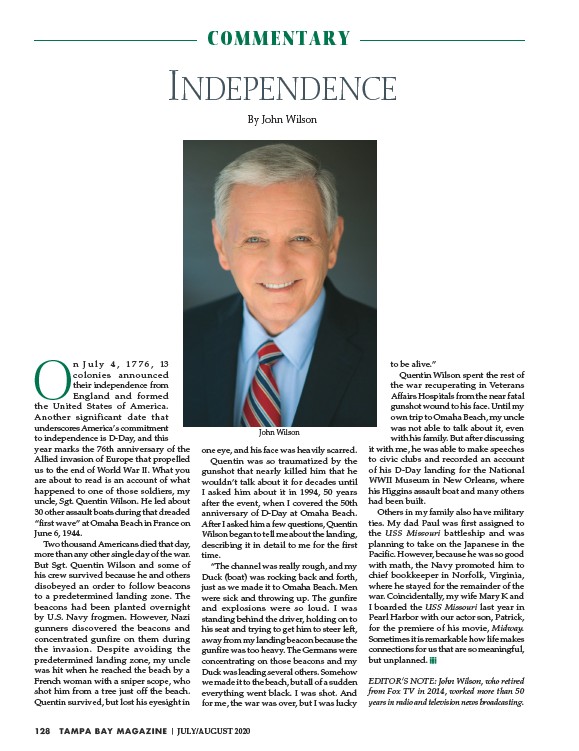
By John Wilson
one eye, and his face was heavily scarred.
Quentin was so traumatized by the
gunshot that nearly killed him that he
wouldn’t talk about it for decades until
I asked him about it in 1994, 50 years
after the event, when I covered the 50th
anniversary of D-Day at Omaha Beach.
After I asked him a few questions, Quentin
Wilson began to tell me about the landing,
describing it in detail to me for the first
time.
“The channel was really rough, and my
Duck (boat) was rocking back and forth,
just as we made it to Omaha Beach. Men
were sick and throwing up. The gunfire
and explosions were so loud. I was
standing behind the driver, holding on to
his seat and trying to get him to steer left,
away from my landing beacon because the
gunfire was too heavy. The Germans were
concentrating on those beacons and my
Duck was leading several others. Somehow
we made it to the beach, but all of a sudden
everything went black. I was shot. And
for me, the war was over, but I was lucky
128 TAMPA BAY MAGAZINE | JULY/AUGUST 2020
to be alive.”
Quentin Wilson spent the rest of
the war recuperating in Veterans
Affairs Hospitals from the near fatal
gunshot wound to his face. Until my
own trip to Omaha Beach, my uncle
was not able to talk about it, even
with his family. But after discussing
it with me, he was able to make speeches
to civic clubs and recorded an account
of his D-Day landing for the National
WWII Museum in New Orleans, where
his Higgins assault boat and many others
had been built.
Others in my family also have military
ties. My dad Paul was first assigned to
the USS Missouri battleship and was
planning to take on the Japanese in the
Pacific. However, because he was so good
with math, the Navy promoted him to
chief bookkeeper in Norfolk, Virginia,
where he stayed for the remainder of the
war. Coincidentally, my wife Mary K and
I boarded the USS Missouri last year in
Pearl Harbor with our actor son, Patrick,
for the premiere of his movie, Midway.
Sometimes it is remarkable how life makes
connections for us that are so meaningful,
but unplanned. 9
EDITOR’S NOTE: John Wilson, who retired
from Fox TV in 2014, worked more than 50
years in radio and television news broadcasting.
COMMENTARY
John Wilson