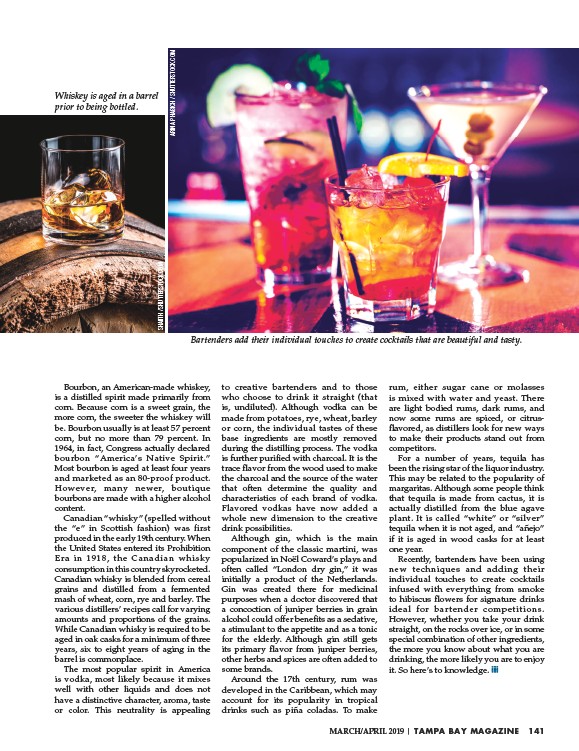
Bartenders add their individual touches to create cocktails that are beautiful and tasty.
MARCH/APRIL 2019 | TAMPA BAY MAGAZINE 141
Bourbon, an American-made whiskey,
is a distilled spirit made primarily from
corn. Because corn is a sweet grain, the
more corn, the sweeter the whiskey will
be. Bourbon usually is at least 57 percent
corn, but no more than 79 percent. In
1964, in fact, Congress actually declared
bourbon “America’s Native Spirit.”
Most bourbon is aged at least four years
and marketed as an 80-proof product.
However, many newer, boutique
bourbons are made with a higher alcohol
content.
Canadian “whisky” (spelled without
the “e” in Scottish fashion) was first
produced in the early 19th century. When
the United States entered its Prohibition
Era in 1918, the Canadian whisky
consumption in this country skyrocketed.
Canadian whisky is blended from cereal
grains and distilled from a fermented
mash of wheat, corn, rye and barley. The
various distillers’ recipes call for varying
amounts and proportions of the grains.
While Canadian whisky is required to be
aged in oak casks for a minimum of three
years, six to eight years of aging in the
barrel is commonplace.
The most popular spirit in America
is vodka, most likely because it mixes
well with other liquids and does not
have a distinctive character, aroma, taste
or color. This neutrality is appealing
to creative bartenders and to those
who choose to drink it straight (that
is, undiluted). Although vodka can be
made from potatoes, rye, wheat, barley
or corn, the individual tastes of these
base ingredients are mostly removed
during the distilling process. The vodka
is further purified with charcoal. It is the
trace flavor from the wood used to make
the charcoal and the source of the water
that often determine the quality and
characteristics of each brand of vodka.
Flavored vodkas have now added a
whole new dimension to the creative
drink possibilities.
Although gin, which is the main
component of the classic martini, was
popularized in Noël Coward’s plays and
often called “London dry gin,” it was
initially a product of the Netherlands.
Gin was created there for medicinal
purposes when a doctor discovered that
a concoction of juniper berries in grain
alcohol could offer benefits as a sedative,
a stimulant to the appetite and as a tonic
for the elderly. Although gin still gets
its primary flavor from juniper berries,
other herbs and spices are often added to
some brands.
Around the 17th century, rum was
developed in the Caribbean, which may
account for its popularity in tropical
drinks such as piña coladas. To make
rum, either sugar cane or molasses
is mixed with water and yeast. There
are light bodied rums, dark rums, and
now some rums are spiced, or citrusflavored,
as distillers look for new ways
to make their products stand out from
competitors.
For a number of years, tequila has
been the rising star of the liquor industry.
This may be related to the popularity of
margaritas. Although some people think
that tequila is made from cactus, it is
actually distilled from the blue agave
plant. It is called “white” or “silver”
tequila when it is not aged, and “añejo”
if it is aged in wood casks for at least
one year.
Recently, bartenders have been using
new techniques and adding their
individual touches to create cocktails
infused with everything from smoke
to hibiscus flowers for signature drinks
ideal for bartender competitions.
However, whether you take your drink
straight, on the rocks over ice, or in some
special combination of other ingredients,
the more you know about what you are
drinking, the more likely you are to enjoy
it. So here’s to knowledge. 9
SHAIITH / SHUTTERSTOCK.COM
ARINA P HABICH / SHUTTERSTOCK.COM
Whiskey is aged in a barrel
prior to being bottled.