Centralized AV System
A centralized AV system offers the benefits of greater
control and easier overall system management. Every
classroom system can be monitored and controlled from
a single, central administrative location. With uniform
system design for every classroom and patching into the
school telecommunication room, a centralized AV system
offers the benefits of easier system management and
greater oversight of power use, including the ability
to automate some processes.
However, a centralized AV system is a complex
system, not only in the number of components but
also in the difficulty of installation and long-term
maintenance needs. A single component failure can
impact not one but multiple rooms—or even the entire
school. This increases the potential for a high system
life cycle cost that may be beyond most school budgets.
Exposed power connection
October/November/December 2019 I 21
cable is unable to provide signal reliability over long dis-
tances. Cat 6 UTP cable may meet network signal requirements
and deliver acceptable performance in an educational
environment, but issues with alien crosstalk mean
signal integrity cannot be reliably ensured.
To eliminate alien crosstalk and avoid dropouts or
link loss at high resolutions, a Cat 6A channel is recommended.
Not only are Cat 6A UTP cabling systems able
to provide infrastructure that is durable and typically less
expensive than alternative forms of AV cabling, they
also offer the ability to upgrade an AV system without
upgrading the entire network. Furthermore, no other
UTP cable option reliably supports AV signal integrity
over long distances while offering easy installation compared
with FTP (shielded) cable. A simple AV system built
on a Cat 6A UTP cabling infrastructure offers maximum
longevity and upgradability.
School district budgets must accommodate many
competing needs, and AV systems are often the final
line item to be budgeted for and the last infrastructure
component to be installed. Upgrades often occur only
Original projector malfunction
because of the failure of a key component, such
as a display or projector.
An AV system’s total life cycle is often not budgeted
for at all. System maintenance and upgrades over the
lifetime of the system are frequently overlooked. Typical
maintenance for a complex, professional AV system can
Old dangling VGA cable
include repairs to projector lamps, control software
updates to touch panel systems, connectivity updates
to accommodate newer technology such as VGA to 1080p
to 4K, and IT service calls for systems that just “are not
working” either due to end-user confusion or component
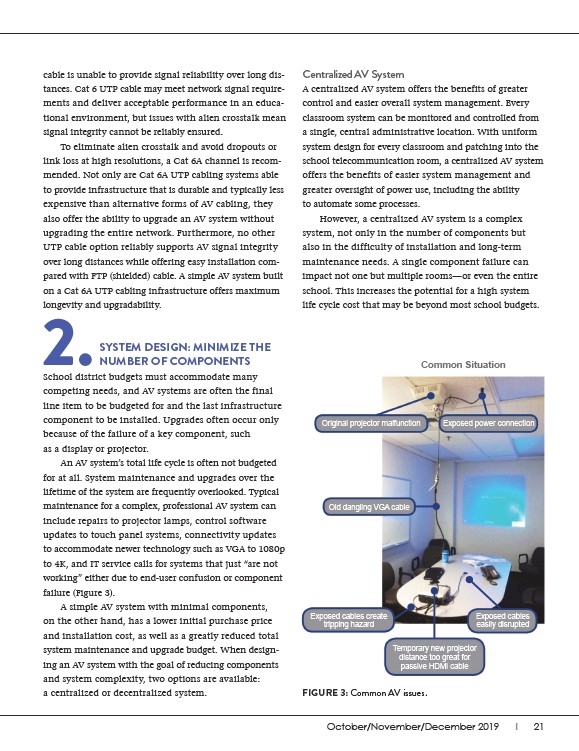
failure (Figure 3).
A simple AV system with minimal components,
Exposed cables create
on the other hand, has a lower initial purchase price
tripping hazard
and installation cost, as well as a greatly reduced total
system maintenance and upgrade budget. When design-
ing an AV system with the goal of reducing components
and system complexity, two options are available:
a centralized or decentralized system. FIGURE 3: Common AV issues.
Exposed cables
easily disrupted
Temporary new projector
distance too great for
passive HDMI cable
2.SYSTEM DESIGN: MINIMIZE THE
NUMBER OF COMPONENTS Common Situation