building’s dynamic lighting. Scheduling, occupancy,
and daylight sensors now provide fully automated shade
control that minimizes heat build-up and eliminates glare,
reinforcing the smart, adaptive nature of the building.
This solution, which was easy to install, also dramatically
reduced cost and workplace disruption. The only
costs are the additional components necessary for ex-
panding this application. Leading window and shade
manufacturers covering the market have already adopted
PoE technology for their motorized shades, offering a wide
array of options.
The PoE powered and controlled shades maximize
energy savings and employee comfort. These allow natural
light to enter the room while controlling unwanted,
uncomfortable glare. Heating and cooling cost savings can
be substantial, and employee productivity improved with
the right daylighting control strategy.
GP’S SUCCESS FACTORS
To highlight some non-core infrastructure technology
related success factors, GP implemented a suite of integrated
cloud-based software solutions to enhance employee
productivity and collaboration in the new work
space. Key capabilities include Office 365, digital signage,
room scheduling, and mobile printing. These capabilities
have been a key enabler to support the new way
of working.
In addition to new technology infrastructure and
software, a key success factor was increasing technology
awareness, training and support services. GP’s Working
Smarter Program was rolled out to provide on-going
training and awareness of the company’s collaboration
The AV and wireless access points
(WAPs) are connected with Cat 6A,
while the PoE lighting is connected
with Cat 5e UTP that is designed
specifically for high power
network applications.
56 I ICT TODAY
and productivity
tools. To enhance
day-to-day technology
support,
a new walk-up Tech
Bar was launched
where employees
could quickly get
support with basic
technology questions
and concerns.
Additionally,
the office itself now
has a “free address”
approach, which
means the majority
of employees are
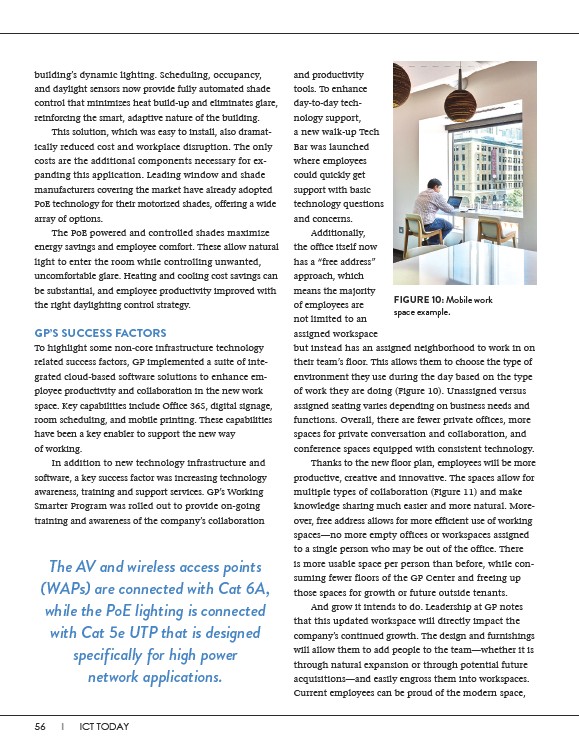
FIGURE 10: Mobile work
space example.
not limited to an
assigned workspace
but instead has an assigned neighborhood to work in on
their team’s floor. This allows them to choose the type of
environment they use during the day based on the type
of work they are doing (Figure 10). Unassigned versus
assigned seating varies depending on business needs and
functions. Overall, there are fewer private offices, more
spaces for private conversation and collaboration, and
conference spaces equipped with consistent technology.
Thanks to the new floor plan, employees will be more
productive, creative and innovative. The spaces allow for
multiple types of collaboration (Figure 11) and make
knowledge sharing much easier and more natural. More-
over, free address allows for more efficient use of working
spaces—no more empty offices or workspaces assigned
to a single person who may be out of the office. There
is more usable space per person than before, while con-
suming fewer floors of the GP Center and freeing up
those spaces for growth or future outside tenants.
And grow it intends to do. Leadership at GP notes
that this updated workspace will directly impact the
company’s continued growth. The design and furnishings
will allow them to add people to the team—whether it is
through natural expansion or through potential future
acquisitions—and easily engross them into workspaces.
Current employees can be proud of the modern space,