that, most telephony circuits were operated over a single
open wire using the earth as a ground-return circuit.
Because this configuration resulted in an unbalanced
circuit, electrical interference issues from power lines
and electric trams led to a method called transposition,
which helped to cancel out the interference, but it was
not as effective as twisted pair.
The longitudinal balance of the two wires is very
important in resisting a given amount of induced vol-
tage before service is adversely affected. However, many
very knowledgeable people in the industry have the un-
fortunate view that twisted pairs eliminate the induced
AC voltage. To be sure, the ideal situation would not
cause any AC voltage to exist between the two conductors.
This condition is usually referred to as the metallic,
transverse mode or differential voltage. What is often
forgotten is that the longitudinal or common-mode
induced voltage is still there! This is the situation that
can cause major problems.
A balanced circuit has two sides that are electrically
alike and symmetrical in respect to ground. In a per-
fectly balanced two-wire circuit, longitudinally induced
(common-mode) voltages cause an equal flow of current
to ground on each conductor. The net metallic (transverse
mode) voltage from the induction is zero. In
practice, of course, perfectly balanced circuits do not
exist! Circuit balance, then, is a measurement of the
differences in longitudinal impedance of each conductor
of a pair or piece of equipment and is expressed in terms
of the induced or applied voltage to the resulting metallic
voltage: Balance = 20 Log10 (longitudinal voltage/metallic
voltage) or Ng - Nm. These two expressions, Ng or noise-toground
(sometimes referred to as power influence) and
Nm or noise metallic (circuit noise) are usually expressed
in terms of dBrnC. A table of generally accepted circuit
performance values for circuit balance, power influence,
and noise metallic are provided in the IEEE standards,
but these values only apply to voice-frequency circuits.
When data circuits are considered, the C-message weighting
characteristics are not involved. That is why data
circuits are more sensitive to lower frequency induction
values and the 3 kHz flat weighting is used to make
their measurements.
38 I ICT TODAY
When physical cable pair troubles or faults occur or
the equipment it is connected to is inherently unbalanced
by design, longitudinal current will not be equal in each
conductor of the pair, and a resulting metallic current
will flow. When this metallic current flows through
a resistance, such as a telephone receiver, metallic voltage
results. Depending on the level of its harmonic content,
this effect could result in noise that can be heard. Longitudinal
voltages and currents, on the other hand, cannot
be heard, but if they are high enough, saturation of the
equipment’s components can cause noise to be generated.
This effect can also occur with test equipment, which
would yield inaccurate readings.
By increasing the number of twists, such as found
in Cat 6A, Cat 7, and Cat 8 cables, further reductions
in near-end crosstalk (NEXT) can allow for higher bandwidth
transmissions.
ENTER THE ALIEN CROSSTALK
(AXT) ISSUE IN LANS
“About 80 percent of the installed base of cabling infrastructures
in enterprise LANs consists of Cat 5e that
operates at 100 MHz or Cat 6 cabling that operates at
250 MHz—both of which are typically able to support
up to 1000 Mb/s 1Gb.”2
Additionally, as reported in 2017 “…more than
70 billion meters of Cat 5e and Cat 6 cable has been
installed over the last 12 years…”3
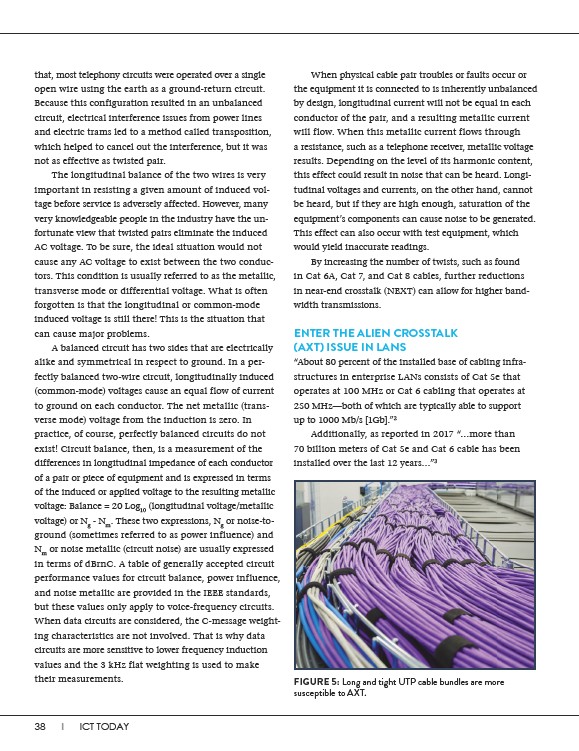
FIGURE 5: Long and tight UTP cable bundles are more
susceptible to AXT.