spectacularly than in Florida. Actually, it
pretty much never was there. All the federal
ban on alcohol, which ran from 1920 to
1933, managed to accomplish was to hand
the lucrative booze business to criminals.
Here was a thirsty tourist trade, local offi cials
vulnerable to corruption, and miles of open
beaches and coves.”
Port Boca Grande was a hotspot for
foreign alcohol products. With ships from
all over the world coming in, you could get
brandy from Spain, gin from Holland, pilsner
beer from Germany and champagne from
France.
People all over the country who could
afford the front money, particularly
gangsters like Al Capone of Chicago, were
making millions bootlegging liquor and
opening speakeasies. Capone would make
a deal with a manufacturer in the tropics,
then hire people to go pick the alcohol up
and bring it to South Florida. From there it
would be distributed through a journey that
consisted of many “relay” captains, until it
got to where it needed to go.
Capone has been quoted saying, “If I
break the law, my customers are as guilty
as I am. When I sell liquor, it’s bootlegging.
When my patrons serve it on silver trays on
Lake Shore Drive, it’s hospitality.”
A case of liquor that sold for $18 in the
Caribbean would cost twice as much when
it got to Florida, and would sometimes be
worth more than $100 by the time it got to
the northern states. Boats would haul the
liquor from the Bahamas to Florida packed
in “hams,” padded with paper and straw.
In a 2012 article in the Coastal Breeze
News, Craig Woodward wrote that, “Our
coastline was ideally suited for this, having
been tested during the second Seminole
Indian War when Cuban guns and
ammunition fl owed up from the Caribbean
into Southwest Florida, to arm the Seminole
warriors battling the U.S. military. By the
time of Prohibition, the moonshiners and
rumrunners operating in the Ten Thousand
Islands were, in many cases, the sons of 19th
century illegal plume hunters. Contraband
was brought in from Bimini, Nassau and
Havana, and, in a similar fashion to the more
recent drug smugglers of the 1970s, often a
mother ship’ would be positioned offshore.
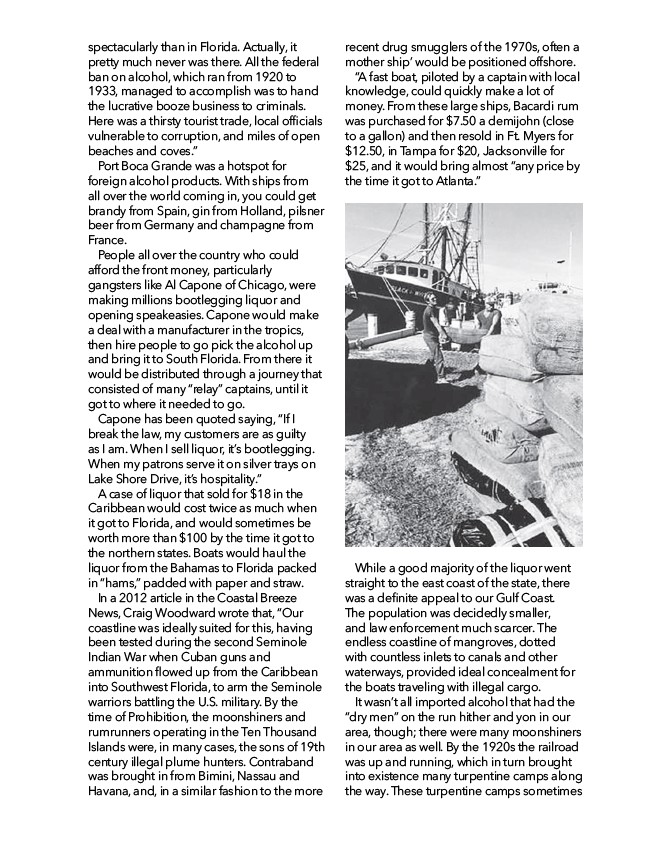
“A fast boat, piloted by a captain with local
knowledge, could quickly make a lot of
money. From these large ships, Bacardi rum
was purchased for $7.50 a demijohn (close
to a gallon) and then resold in Ft. Myers for
$12.50, in Tampa for $20, Jacksonville for
$25, and it would bring almost “any price by
the time it got to Atlanta.”
While a good majority of the liquor went
straight to the east coast of the state, there
was a defi nite appeal to our Gulf Coast.
The population was decidedly smaller,
and law enforcement much scarcer. The
endless coastline of mangroves, dotted
with countless inlets to canals and other
waterways, provided ideal concealment for
the boats traveling with illegal cargo.
It wasn’t all imported alcohol that had the
“dry men” on the run hither and yon in our
area, though; there were many moonshiners
in our area as well. By the 1920s the railroad
was up and running, which in turn brought
into existence many turpentine camps along
the way. These turpentine camps sometimes