January/February • 2021 • GASPARILLA MAGAZINE 71
… enough to make a very large profi t
without expending a penny on their own. It
was almost like winning the lottery, for those
who were willing to take the risk.
Once more, the Gulf of Mexico had
proven to be “the” place where many would
take their chances to make good on a big
haul of illegal product. For every boat that
was caught with a cargo of drugs, there
were probably 100 that got away clean.
There was so much money to be made; it
wasn’t unusual to see local fi shermen sitting
on the porch of their newly-remodeled
home, with a Cadillac in the driveway and a
brand-new skiff at their dock.
Two of the most notorious spots for
drug runners were also infamous during
the Prohibition era – Everglades City and
Chokoloskee Island. They are tiny little towns
that don’t draw much attention, and a large
number of their populations were willing
to take massive risks to make money. The
mother ships that brought the drugs
got bigger and bigger; sometimes
even freighters brought the drugs.
One incident was recorded in a
book titled, “Saltwater Cowboy,”
by former drug smuggler Tim
McBride, who said that more
than once they met very large
cattle ships that contained not
only cows, but drugs. The hands
aboard the boat would throw
the cattle in the water to drown
so they could unload the bales
of marijuana hidden beneath
them. Of all the things that
McBride saw during his years as
a smuggler, the drowning cows seemed to
be very horrifi c to him.
In the early 1980s federal agents were
starting to catch on to these remote
locations, and in 1983 they tried a fi rst
“Operation Everglades” drug bust. It didn’t
work out quite the way they had planned,
as reporters caught wind of the bust and
descended upon the town before law
enforcement even showed up. There was
eventually an “Operation Everglades II,” and
it was a bit more successful ... but the drug
trade still continued on.
You can be guaranteed if you know some
of the older fi shing families of the island,
you probably know an ex-drug smuggler.
There were many incidents that took
place in Boca Grande that didn’t necessarily
involve islanders, though, including some
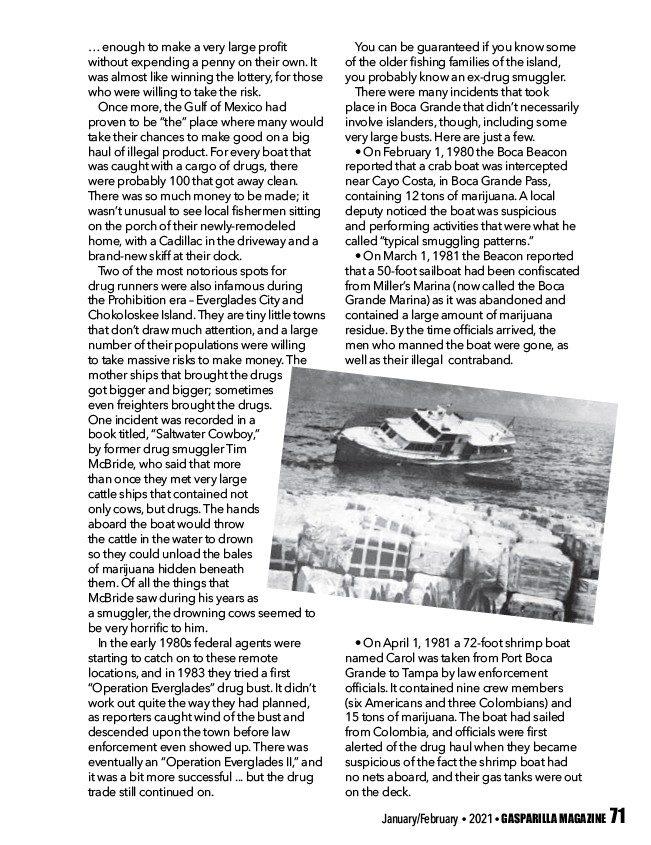
very large busts. Here are just a few.
• On February 1, 1980 the Boca Beacon
reported that a crab boat was intercepted
near Cayo Costa, in Boca Grande Pass,
containing 12 tons of marijuana. A local
deputy noticed the boat was suspicious
and performing activities that were what he
called “typical smuggling patterns.”
• On March 1, 1981 the Beacon reported
that a 50-foot sailboat had been confi scated
from Miller’s Marina (now called the Boca
Grande Marina) as it was abandoned and
contained a large amount of marijuana
residue. By the time offi cials arrived, the
men who manned the boat were gone, as
well as their illegal contraband.
• On April 1, 1981 a 72-foot shrimp boat
named Carol was taken from Port Boca
Grande to Tampa by law enforcement
offi cials. It contained nine crew members
(six Americans and three Colombians) and
15 tons of marijuana. The boat had sailed
from Colombia, and offi cials were fi rst
alerted of the drug haul when they became
suspicious of the fact the shrimp boat had
no nets aboard, and their gas tanks were out
on the deck.