how he got involved with the business, but
the fact remains that as President Nixon was
cracking down on the fl ow of marijuana
from Mexico, street prices were climbing
higher and higher. The lure of such easy
money, especially for a well-respected
captain who rubbed elbows
with some of the country’s
most elite players, came
calling. By the early 1970s,
Stansel was stashing stacks
of bills in his parents’ attic.
The process was simple.
Stansel would travel to
Jamaica on an alleged
fi shing run, where the
pot was grown in the
hills, then brought out in
burlap sacks and sold
that way. In Jamaica at
that time, the price of
marijuana was very
cheap, about $10 a
pound, but in the
United States you
could sell that same
pound for $375.
Eventually Stansel
even spread out
the tentacles of
his business to
Colombia, and the
stakes became
even higher.
While it was a
fi ve-day trip from
Jamaica in his
boat, it was still only 10 days
from Colombia … and the product was
much better. Stansel would load his boat
down with massive bales and fi nd his way to
any of the endless mangrove coves around
the area to fi nish the transactions.
Eventually he had so much money, he set
up offshore accounts in the Cayman Islands,
bought more boats and even started his
own seafood and boat-building companies
outside the United States. As people
watched his boats come into port, riding
low in the water but with bone-dry nets and
with no ice purchased, they started to realize
something was truly fi shy. Stansel was
eventually arrested, but before prosecution
he disappeared and was never tried for his
crimes.
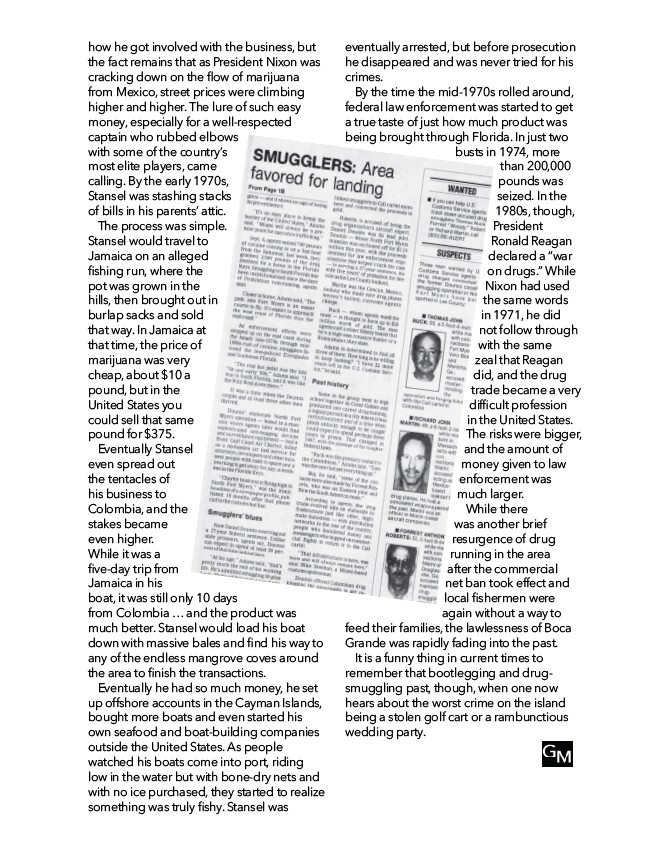
By the time the mid-1970s rolled around,
federal law enforcement was started to get
a true taste of just how much product was
being brought through Florida. In just two
busts in 1974, more
than 200,000
pounds was
seized. In the
1980s, though,
President
Ronald Reagan
declared a “war
on drugs.” While
Nixon had used
the same words
in 1971, he did
not follow through
with the same
zeal that Reagan
did, and the drug
trade became a very
diffi cult profession
in the United States.
The risks were bigger,
and the amount of
money given to law
enforcement was
much larger.
While there
was another brief
resurgence of drug
running in the area
after the commercial
net ban took effect and
local fi shermen were
again without a way to
feed their families, the lawlessness of Boca
Grande was rapidly fading into the past.
It is a funny thing in current times to
remember that bootlegging and drugsmuggling
past, though, when one now
hears about the worst crime on the island
being a stolen golf cart or a rambunctious
wedding party.