BRINGING DCIM SOFTWARE
TO THE TABLE
Once the monitoring capability is
in place, DCIM simplifies site-level
management.
A common theme across all
use cases is the utilization of a
centralized management application
(DCIM) that will collect data from
all intelligent PDUs and perhaps
other infrastructure equipment
located within the data center.
DCIM allows organizations to
effectively utilize all the data
through customizable dashboards,
trend reports and auditable logs.
While DCIM has much to offer,
consider these key features:
• For flexibility, the application
should be vendor-neutral
to support all categories of
infrastructure equipment within
the data center.
• For quick setup, the application
should support auto discovery,
as well as the ability to import
information from other
applications such as Excel or Visio.
• For ease of deployment, it should
have an embedded database with
$6,240
Traditional
Networking
$390
Secure
Array
60 I ICT TODAY
enough scalability to support data
points obtained from hundreds to
thousands of devices.
• For enhanced security, the
application should support
enterprise authentication services,
such as LDAP or Active Directory.
• For easy integration, the
application should support
application programming
interfaces (APIs) to connect with
other applications being used (e.g.,
building management systems,
ticketing systems).
• For enhanced reporting, the
database should support protocols
that allow easy, customizable
data exports not native to the
application.
MAXIMIZING ROI:
INTELLIGENT COLLABORATION
With an average data center size
having several hundred intelligent
rack PDUs, the question becomes,
“How do you effectively use the
information polled from all of
them to ensure availability of all
applications?”
FIGURE 3: Select a simple, yet robust
DCIM tool that provides the information
and controls needed to fully utilize existing
infrastructure resources, while alerting to
trouble before it causes downtime.
1. MINIMIZE NETWORKING
PORTS AND ENSURE
FAILOVER SUPPORT
Putting PDUs in a daisy chain (IP
consolidation) is a common practice.
However, a traditional daisy chain
has no failover support. This means
if connectivity is lost, users cannot
get any information downstream of
the PDU.
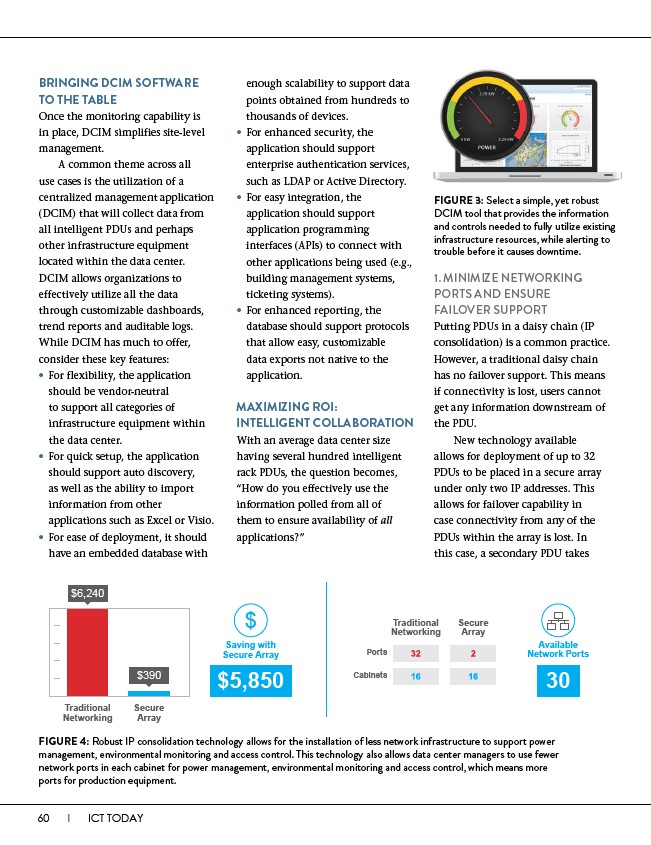
New technology available
allows for deployment of up to 32
PDUs to be placed in a secure array
under only two IP addresses. This
allows for failover capability in
case connectivity from any of the
PDUs within the array is lost. In
this case, a secondary PDU takes
$
Saving with
Secure Array
$5,850
Available
Network Ports
30
Traditional
Networking
Secure
Array
Ports
Cabinets
FIGURE 4: Robust IP consolidation technology allows for the installation of less network infrastructure to support power
management, environmental monitoring and access control. This technology also allows data center managers to use fewer
network ports in each cabinet for power management, environmental monitoring and access control, which means more
ports for production equipment.