Often, you will want to secure your boat
in a specific location. If no dock or
mooring is available, you will need to use
an anchor. Master the art of anchoring if
you want to cruise with peace of mind. Poor
equipment and bad anchoring practices can
lead to great inconvenience, possible damage,
and potential risk to you and your crew
as well as to boats and objects around you.
If your boat drags its anchor, you may find
yourself drifting into other boats or onto
rocks or beaches. If you drift into and damage
other vessels, or foul their anchor (tangle
your anchor with theirs so it does not hold
their boat in position), you are responsible
for any damage incurred. Your preparations
for anchoring include using the navigation
chart to determine: the type of bottom, best
position considering tide, currents, prevailing
winds, location of visual aids, location
of dangerous shoals and wrecks; positions
of other boaters at anchor; and distances to
shore or provisioning docks. Then determine
the type of anchor and length of rode,
brief the crew on their responsibilities and
be flexible.
ANCHORING EQUIPMENT
There are many kinds of anchors. No one
anchor is best—each has its strengths and
weaknesses.
The correct anchor for your boat
depends on the:
• Size and weight of your boat
• Type of your boat (storage area, weight)
• Kinds of seabed where you intend to
anchor
• Amount of wind and current you expect
to encounter.
As a starting point, ask marine supply
stores and fellow boaters in your area what
they recommend. While local knowledge is
always valuable, only personal experience
in anchoring your boat will tell you if you
have made the correct choice. In any case,
always purchase a quality anchor.
What you are purchasing in an
anchor is holding power. Factors affecting
holding power include:
• Design
• Weight
• Material of construction
Anchors almost always hold by digging
into the bottom, seldom by weight alone.
Design strongly influences an anchor’s ability
to hook itself into the bottom.
The rode (anchor line) must be of the
proper size and make-up for the boat and
the conditions; its length should be based
on the anticipated depth and conditions.
Parts of an Anchor
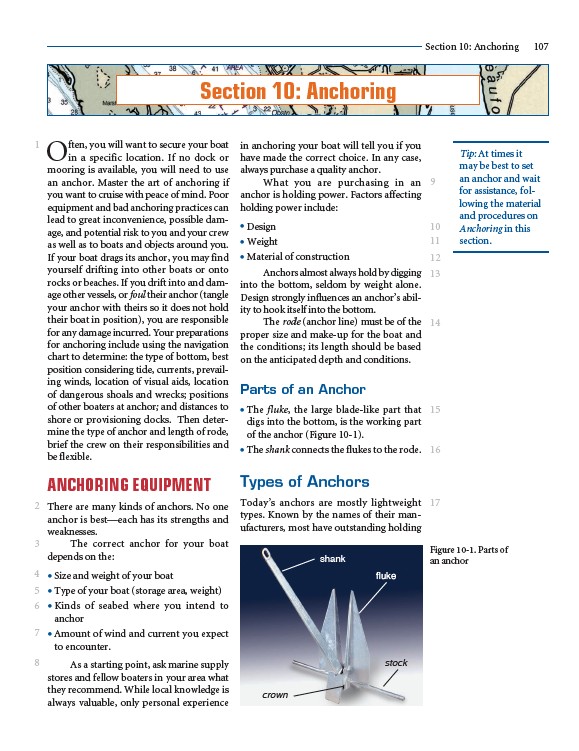
• The fluke, the large blade-like part that
digs into the bottom, is the working part
of the anchor (Figure 10-1).
• The shank connects the flukes to the rode.
Types of Anchors
Today’s anchors are mostly lightweight
types. Known by the names of their manufacturers,
most have outstanding holding
Section 10: Anchoring 107
Section 10: Anchoring
shank
��������
stock
crown
Figure 10-1. Parts of
an anchor
1
2
3
4
5
6
7
8
9
10
11
12
13
14
15
16
17
Tip: At times it
may be best to set
an anchor and wait
for assistance, following
the material
and procedures on
Anchoring in this
section.