boat effects. While it’s something you can
do, it’s best to consult a professional compass
adjuster. The USPS Piloting Course will
show you some techniques, or consider
taking the USPS Using GPS Seminar.
In this course, we will consider a vessel’s
deviation to be 0°. This subject is discussed
more fully in advanced courses such
as the USPS Piloting Course.
CALCULATING A
STEERING COURSE
When we drew the course line from G C
“1” to RG “D” GONG on our Bowditch Bay
practice chart, we found the true course to
be 067°. We referenced it to true north,
because true is the language of the chart.
However, you steer by a compass.
In order to steer the desired course, we
must make a correction to convert the true
course of the chart to the magnetic course
of the compass. That correction is variation,
the angle between true north and
magnetic north, as explained above. (We
must also correct for deviation, but here we
are assuming a compass with no deviation.)
There is a simple rule: When going
from true to compass, add westerly variation
and subtract easterly variation. As a
memory aid, remember SET—Subtract
East from True
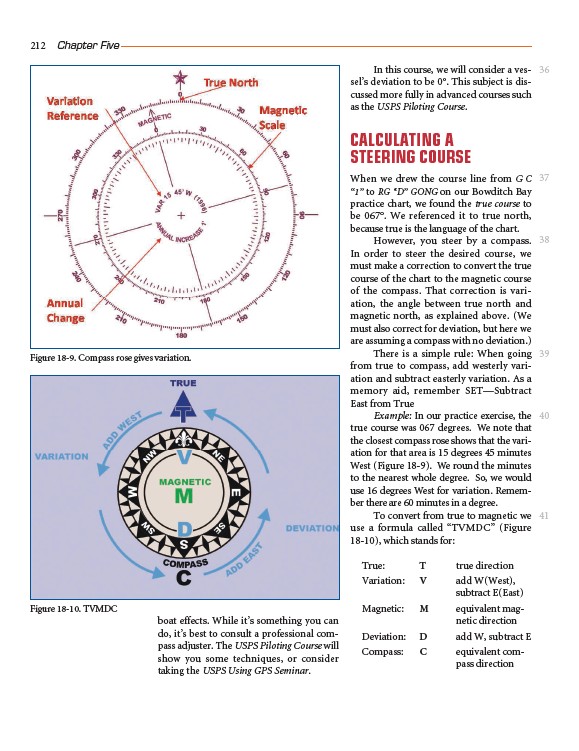
Example: In our practice exercise, the
true course was 067 degrees. We note that
the closest compass rose shows that the variation
for that area is 15 degrees 45 minutes
West (Figure 18-9). We round the minutes
to the nearest whole degree. So, we would
use 16 degrees West for variation. Remember
there are 60 minutes in a degree.
To convert from true to magnetic we
use a formula called “TVMDC” (Figure
18-10), which stands for:
True: T true direction
Variation: V add W(West),
subtract E(East)
Magnetic: M equivalent magnetic
direction
Deviation: D add W, subtract E
Compass: C equivalent compass
direction
212 Chapter Five
36
37
38
39
40
41
Figure 18-9. Compass rose gives variation.
Figure 18-10. TVMDC