72 Chapter Two
Figure 5-17. Lighted
navigation aids—day
and night
Light Colors
The light color is how you distinguish different
types of marks at night (Figure 5-17).
• The lights on lateral marks match the
color of the mark—red or green.
• Preferred-channel marks have light colors
matching the top band of color—red
or green.
• Safe water and isolated danger buoys
have white lights.
• Special-purpose buoys have yellow lights.
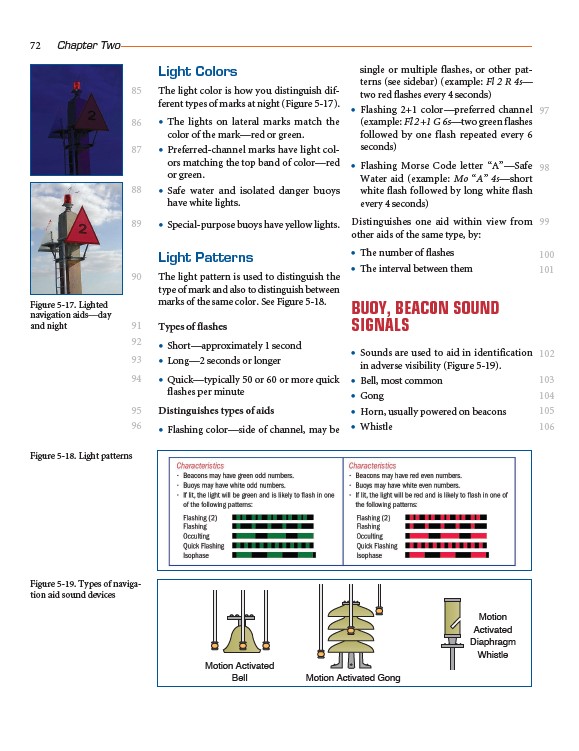
Light Patterns
The light pattern is used to distinguish the
type of mark and also to distinguish between
marks of the same color. See Figure 5-18.
Types of flashes
• Short—approximately 1 second
• Long—2 seconds or longer
• Quick—typically 50 or 60 or more quick
flashes per minute
Distinguishes types of aids
• Flashing color—side of channel, may be
single or multiple flashes, or other patterns
(see sidebar) (example: Fl 2 R 4s—
two red flashes every 4 seconds)
• Flashing 2+1 color—preferred channel
(example: Fl 2+1 G 6s—two green flashes
followed by one flash repeated every 6
seconds)
• Flashing Morse Code letter “A”—Safe
Water aid (example: Mo “A” 4s—short
white flash followed by long white flash
every 4 seconds)
Distinguishes one aid within view from
other aids of the same type, by:
• The number of flashes
• The interval between them
BUOY, BEACON SOUND
SIGNALS
• Sounds are used to aid in identification
in adverse visibility (Figure 5-19).
• Bell, most common
• Gong
• Horn, usually powered on beacons
• Whistle
97
98
99
100
101
102
103
104
105
106
Figure 5-19. Types of navigation
aid sound devices
85
86
87
88
89
90
91
92
93
94
95
96
Figure 5-18. Light patterns
Motion Activated
Bell Motion Activated Gong
Motion
Activated
Diaphragm
Whistle