160 Chapter Four
25
26
27
28
29
30
31
32
33
34
35
36
37
38
39
• They should be strong enough to hold
the total weight of the entire trailer when
loaded, and just long enough to support
the coupler so it will not hit the ground if
the ball hitch breaks.
• Allow enough slack in the chain to permit
tight turns under normal driving circumstances.
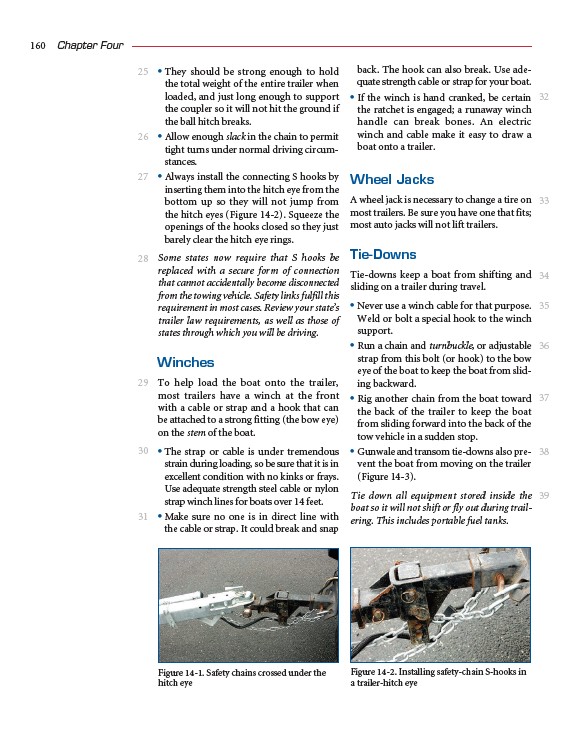
• Always install the connecting S hooks by
inserting them into the hitch eye from the
bottom up so they will not jump from
the hitch eyes (Figure 14-2). Squeeze the
openings of the hooks closed so they just
barely clear the hitch eye rings.
Some states now require that S hooks be
replaced with a secure form of connection
that cannot accidentally become disconnected
from the towing vehicle. Safety links fulfill this
requirement in most cases. Review your state’s
trailer law requirements, as well as those of
states through which you will be driving.
Winches
To help load the boat onto the trailer,
most trailers have a winch at the front
with a cable or strap and a hook that can
be attached to a strong fitting (the bow eye)
on the stem of the boat.
• The strap or cable is under tremendous
strain during loading, so be sure that it is in
excellent condition with no kinks or frays.
Use adequate strength steel cable or nylon
strap winch lines for boats over 14 feet.
• Make sure no one is in direct line with
the cable or strap. It could break and snap
back. The hook can also break. Use adequate
strength cable or strap for your boat.
• If the winch is hand cranked, be certain
the ratchet is engaged; a runaway winch
handle can break bones. An electric
winch and cable make it easy to draw a
boat onto a trailer.
Wheel Jacks
A wheel jack is necessary to change a tire on
most trailers. Be sure you have one that fits;
most auto jacks will not lift trailers.
Tie-Downs
Tie-downs keep a boat from shifting and
sliding on a trailer during travel.
• Never use a winch cable for that purpose.
Weld or bolt a special hook to the winch
support.
• Run a chain and turnbuckle, or adjustable
strap from this bolt (or hook) to the bow
eye of the boat to keep the boat from sliding
backward.
• Rig another chain from the boat toward
the back of the trailer to keep the boat
from sliding forward into the back of the
tow vehicle in a sudden stop.
• Gunwale and transom tie-downs also prevent
the boat from moving on the trailer
(Figure 14-3).
Tie down all equipment stored inside the
boat so it will not shift or fly out during trailering.
This includes portable fuel tanks.
Figure 14-1. Safety chains crossed under the
hitch eye
Figure 14-2. Installing safety-chain S-hooks in
a trailer-hitch eye