Note: If your boat bears a label containing
the words, “This boat complies
with U.S. Coast Guard safety standards,”
you can assume that your boat’s ventilation
system meets regulations.
Flame Arrestors
• All gasoline engines, except outboard
motors, must be equipped with approved
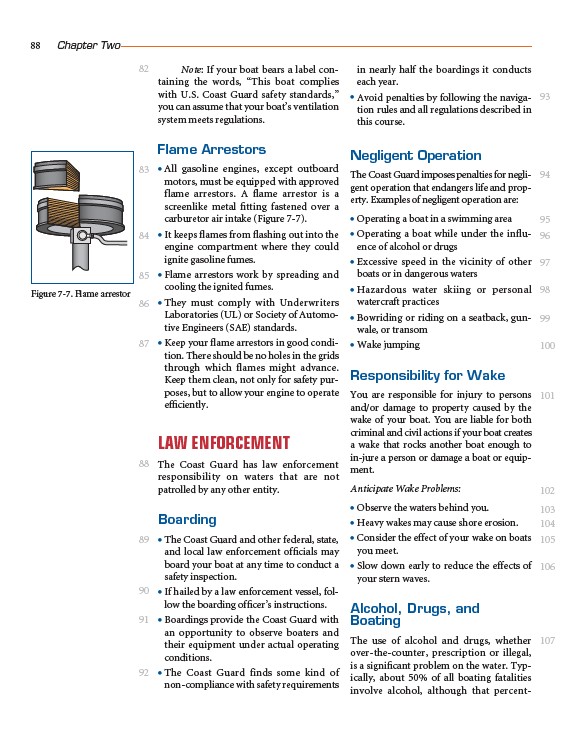
flame arrestors. A flame arrestor is a
screenlike metal fitting fastened over a
carburetor air intake (Figure 7-7).
• It keeps flames from flashing out into the
engine compartment where they could
ignite gasoline fumes.
• Flame arrestors work by spreading and
cooling the ignited fumes.
• They must comply with Underwriters
Laboratories (UL) or Society of Automotive
Engineers (SAE) standards.
• Keep your flame arrestors in good condition.
There should be no holes in the grids
through which flames might advance.
Keep them clean, not only for safety purposes,
but to allow your engine to operate
efficiently.
LAW ENFORCEMENT
The Coast Guard has law enforcement
responsibility on waters that are not
patrolled by any other entity.
Boarding
• The Coast Guard and other federal, state,
and local law enforcement officials may
board your boat at any time to conduct a
safety inspection.
• If hailed by a law enforcement vessel, follow
the boarding officer’s instructions.
• Boardings provide the Coast Guard with
an opportunity to observe boaters and
their equipment under actual operating
conditions.
• The Coast Guard finds some kind of
non-compliance with safety requirements
in nearly half the boardings it conducts
each year.
• Avoid penalties by following the navigation
rules and all regulations described in
this course.
Negligent Operation
The Coast Guard imposes penalties for negligent
operation that endangers life and property.
Examples of negligent operation are:
• Operating a boat in a swimming area
• Operating a boat while under the influence
of alcohol or drugs
• Excessive speed in the vicinity of other
boats or in dangerous waters
• Hazardous water skiing or personal
watercraft practices
• Bowriding or riding on a seatback, gunwale,
or transom
• Wake jumping
Responsibility for Wake
You are responsible for injury to persons
and/or damage to property caused by the
wake of your boat. You are liable for both
criminal and civil actions if your boat creates
a wake that rocks another boat enough to
in-jure a person or damage a boat or equipment.
Anticipate Wake Problems:
• Observe the waters behind you.
• Heavy wakes may cause shore erosion.
• Consider the effect of your wake on boats
you meet.
• Slow down early to reduce the effects of
your stern waves.
Alcohol, Drugs, and
Boating
The use of alcohol and drugs, whether
over-the-counter, prescription or illegal,
is a significant problem on the water. Typically,
about 50% of all boating fatalities
involve alcohol, although that percent-
88 Chapter Two
Figure 7-7. Flame arrestor
82
83
84
85
86
87
88
89
90
91
92
93
94
95
96
97
98
99
100
101
102
103
104
105
106
107