Vessel Certification Label
Boat manufacturers affix a certification
label to each boat. The label states that the
boat complies with applicable USCG Safety
Standards.
It is illegal to alter or remove a certification
label.
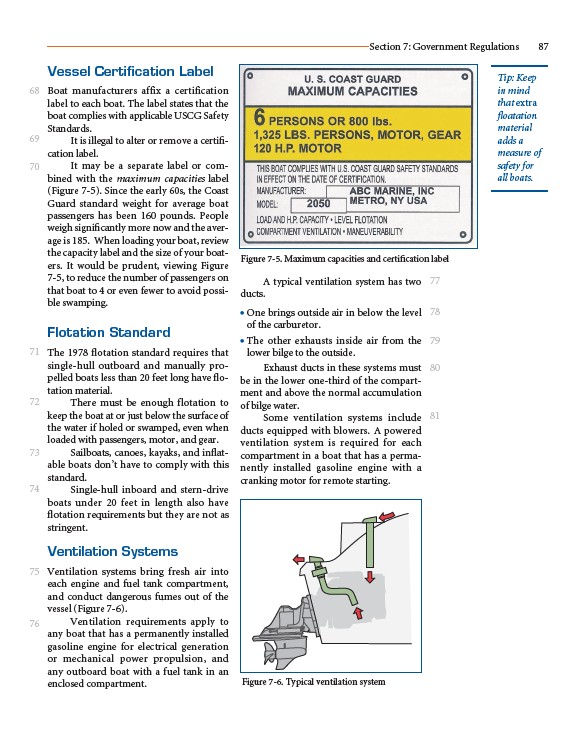
It may be a separate label or combined
with the maximum capacities label
(Figure 7-5). Since the early 60s, the Coast
Guard standard weight for average boat
passengers has been 160 pounds. People
weigh significantly more now and the average
is 185. When loading your boat, review
the capacity label and the size of your boaters.
It would be prudent, viewing Figure
7-5, to reduce the number of passengers on
that boat to 4 or even fewer to avoid possible
swamping.
Flotation Standard
The 1978 flotation standard requires that
single-hull outboard and manually propelled
boats less than 20 feet long have flotation
material.
There must be enough flotation to
keep the boat at or just below the surface of
the water if holed or swamped, even when
loaded with passengers, motor, and gear.
Sailboats, canoes, kayaks, and inflatable
boats don’t have to comply with this
standard.
Single-hull inboard and stern-drive
boats under 20 feet in length also have
flotation requirements but they are not as
stringent.
Ventilation Systems
Ventilation systems bring fresh air into
each engine and fuel tank compartment,
and conduct dangerous fumes out of the
vessel (Figure 7-6).
Ventilation requirements apply to
any boat that has a permanently installed
gasoline engine for electrical generation
or mechanical power propulsion, and
any outboard boat with a fuel tank in an
enclosed compartment.
Section 7: Government Regulations 87
Figure 7-5. Maximum capacities and certification label
A typical ventilation system has two
ducts.
• One brings outside air in below the level
of the carburetor.
• The other exhausts inside air from the
lower bilge to the outside.
Exhaust ducts in these systems must
be in the lower one-third of the compartment
and above the normal accumulation
of bilge water.
Some ventilation systems include
ducts equipped with blowers. A powered
ventilation system is required for each
compartment in a boat that has a permanently
installed gasoline engine with a
cranking motor for remote starting.
Tip: Keep
in mind
that extra
floatation
material
adds a
measure of
safety for
all boats.
Figure 7-6. Typical ventilation system
68
69
70
71
72
73
74
75
76
77
78
79
80
81